You're working really hard. But the results aren't keeping up?
It's not laziness. It's not lack of talent. Plenty of people
work hard all day and still feel like they're constantly
running in place, without clarity on what actually drives
results. Pier9 measures
how your effort turns into results
and, one layer deeper, what sustains that pattern.
Stop assuming the problem is "not trying hard enough"
See whether you're spinning your wheels or actually
moving forward
30 questions · instant result · no card and no sign-up to
start
Does this sound familiar?
Ends the day exhausted and still feels like nothing moved
forward
Says yes to everything, then can't figure out what to
prioritize
Works hard, but recognition doesn't come in the same
proportion
Knows something needs to change, but doesn't know where
to start
Beats themselves up for "not doing enough," even when
already at their limit
If you recognized yourself in at least one of these, the
problem is probably not lack of dedication.
Why this happens
When effort is high and results don't keep up, guilt,
anxiety, and that feeling of always being behind show up,
even when you're doing everything you can.
Pier9 doesn't measure intelligence or personality. It shows
how your effort turns into results today
and where to adjust first, without asking you to work more.
The method
Two layers, not one
Almost every test stops here: it tells you what you do. Pier9
also measures why you do it. Two people in the
same behavior quadrant can be there for opposite reasons, and
the way out is different for each.
Behavior Layer
Effort × Result
How much of your effort turns into delivery, and how much of
it you could save. The best spot isn't the one with the most
effort: it's the one with more result and less wear. The
crossing places you in one of the 9 profiles.
Free · instant result
Motivation Layer
Purpose × Incentive
What sustains that behavior. It separates what comes from
you (purpose) from what your environment gives back:
recognition, feedback, perspective, autonomy. There are
4 quadrants that combine with the 9
profiles.
Revealed in the full report
Low incentive isn't a flaw in you. Purpose is
a trait of yours; incentive is a fact about
where you are. Separating the two changes what kind
of decision makes sense: negotiate, make your work visible
or change context.
Social proof
People who've already taken the assessment
I recognized my day-to-day in the questions: always in
execution mode, little time to think. The result matched
who I am and showed me a way to build a smarter pace.
Jonas R.🐝 Operational
Over time I realized I was working a lot and the results
weren't coming at the same rate. The test put words to
what I felt: too much detail, slow delivery. Now I
evaluate my actions and results much better.
Breno S.🦚 Perfectionist
In just a few minutes I understood I was on the right
track. I've always had clarity about my dreams and
goals. But the reports showed me I need more effort and
focus in some areas of my day-to-day.
Thaís S.🐘 Tactician
Behavior Layer
Effort × Result
You respond to real everyday situations: decisions,
priorities, pressure, how you execute. Each answer adds to
both axes, and the crossing places you in
one of 9 profiles.
It's not about working more. It's about understanding
whether you're putting effort in the right place, and
which profile best describes how you act today.
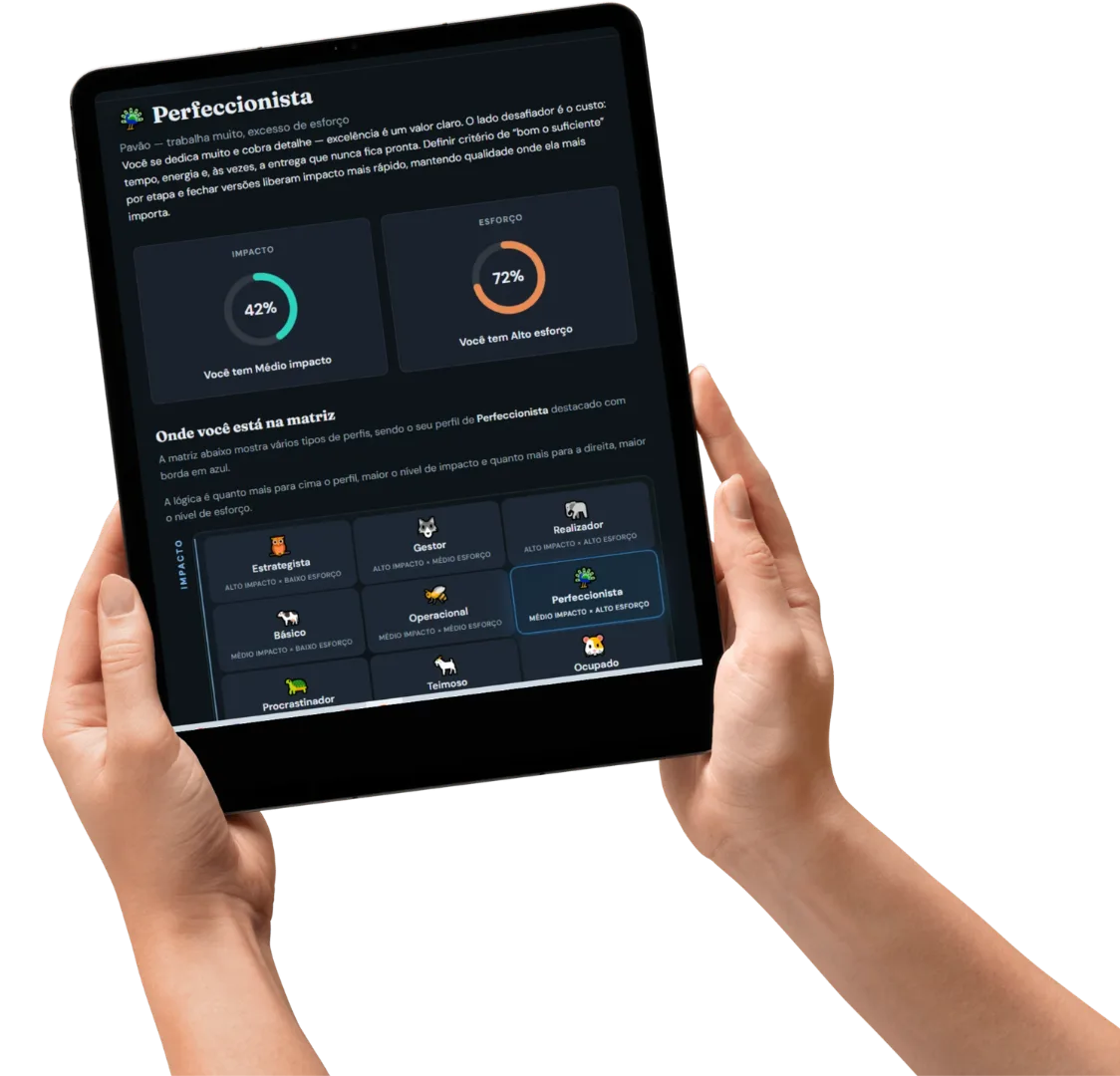
The higher up, the more result; the further right, the less
effort. The best spot is top right: more
result with less wear.
Each profile has an animal and an essence. They're different
ways of converting effort into results, each with its own
strengths and costs. The destination is the Strategist: more
result with less wear.
🦉StrategistOwlHigh result with little wear: focus, precision, and leverage
🐝OperatorBeeSteady, disciplined execution
🦚PerfectionistPeacockLots of effort, part of it spent on polishing
🐹BusyHamsterLots of effort without direction: going in circles
The layer underneath: the fuel. Purpose is what comes from
you; incentive is what your environment gives back. The four
quadrants cross with the 9 profiles and generate
36 different readings.
One example from the report: the Committed Strategist
produces results with little effort and genuinely believes in
what they do, yet still isn't recognized accordingly.
Efficiency without visibility tends to be read as "not doing
enough."
More purpose
🎯
Committed
More purpose× Less incentive
Genuinely cares, without a matching return
🚀
Engaged
More purpose× More incentive
Wants to do it and is rewarded for it
⚓
Disengaged
Less purpose× Less incentive
Neither internal drive nor external return
🎁
Extrinsic
Less purpose× More incentive
Driven by external stimulus, without real involvement
More incentive
Example of a full result
🦚Committed PerfectionistMid result × more effort · More purpose × less
incentive
The Committed Perfectionist delivers with technical
excellence and genuinely believes in what they do, but the
slow process holds back the result, and the lack of external
return makes that effort feel invisible.
What you discover in a few minutes
Your profile among 9 effort × result patterns
Your score on each axis, with an interpreted reading
Where you spend effort without proportional return
Whether you're in a border zone between two quadrants
Where to start adjusting, without asking you to work
more
No right or wrong answers. No judgment.
To start100% free
Time10 to 16 minutes
Format30 questions · single choice
Layers2 matrices · 36 combinations
LanguagesPT · EN · ES
Staying stuck in the same pattern wears you down more than
taking the free assessment.
Who's behind the method
Bruno Siqueira
Creator of the Pier9 method
He lived firsthand the frustration of pushing hard without
seeing the results: a perfectionist profile, always
running, never seeing the expected return. That pain is
what gave rise to the methodology behind Pier9.
Law degree, with a specialization in Project
Management
MBA in Human Potential Development (Franklin
Covey)
MBA in Strategic People Management (FGV)
Entrepreneur since 2018 · has worked with Sebrae,
Dentsply Sirona, Óticas Diniz, Bolo da Madre and other
companies
Strengths and saboteurs, with the answers that weighed most
Motivation Layer: Purpose × Incentive revealed
Secondary profile and border zones
The combined reading of both matrices, case by case
Typical risks and a step-by-step growth plan
Comparison with all nine matrix profiles
Live
1:1 debrief with a specialist
$59one-time payment
45-minute video session
Report reading applied to your context
Open questions: what the numbers don't say
Three priorities defined together with you
Full report included
Credited in full if you join the Program within 7 days
Changing the pattern
A diagnosis alone doesn't change behavior. 12 weeks in a cohort,
from your current profile to 🦉 Engaged Strategist.
Founding cohort
Pier9 Program
$27912-week cohort · one-time payment
Cohort of 10 people at most. Join the first two sessions: if
it isn't what you expected, we refund 100%.
Full report included
Platform with the 6 steps and the program's tools
12 weekly live sessions of 90 min, recorded
Cohort community for the full 12 weeks
Retest in weeks 6 and 12, with a before and after
Founding cohort bonus: 6 months of Pier9 Maintenance free
Prices in US dollars (USD).
Payments open soon. In the app you join the
priority list and lock in the promotional price.
See all plans
The most common path
Take the free assessment and see your profile on the
matrix.
Open the full report to understand the root of the
pattern.
To actually change the pattern, join the Pier9 Program or
start with a debrief.
Each step makes sense on its own. There's no rush.
Frequently asked questions
Is the test really free?
Yes. The full assessment and your Behavior Layer result (Effort
× Result) are free and require no credit card.
How long does the assessment take?
About 12 minutes (between 10 and 16, depending on your
pace). It's 30 single-choice questions about everyday
situations, with no on-screen timer.
What is the Motivation Layer?
The Behavior Layer measures how your effort turns into
results. The Motivation Layer measures the motivational root (purpose × incentive) and
explains why the pattern holds. It's revealed in
the full report.
What does the full report add?
The free result shows the Behavior Layer: what you do. The
full report ($19) adds saboteurs and strengths, the
Motivation Layer (why you do it), and the combined reading
of both, which is where the most useful insights are.
How does the Pier9 Program work?
12 weeks with a start and an end, in a cohort of up to 10
people. There's a 90-minute live session every week; in
between, you apply the tools on the platform and talk with
the cohort in the community. It costs $279, paid once.
What if the Program isn't for me?
Join the first two sessions. If it isn't what you expected,
we refund 100%.
Is there a right or wrong answer?
No. The goal isn't to measure intelligence or personality,
but to understand how you convert effort into results.
Answer honestly: that's what makes the diagnosis useful.
Does a low incentive score mean I'm the problem?
No. Purpose is a trait of yours; incentive describes what
your environment gives back. A low incentive is a fact
about where you are, not a flaw in you, and it changes
what kind of decision makes sense.
Do I need to sign up before taking the test?
No. The assessment works anonymously and an account is
optional. Name and email are only requested if you want to
save your result or open the report, not on the first
click.
Is the test available in other languages?
Yes: Portuguese, English, and Spanish. The app switches
languages without losing your test progress.
Before you push yourself once more, find out if the problem is
effort, direction, or both.